
Cichlidae · Haplochromini · Victoria Basin
The Extinction That Never Was
A critical re-examination of the evidence — and the absence of it — behind forty years of claims about Lake Victoria's haplochromine cichlids.
Editorial position
Mass Restructuring, Not Mass Extinction
We do not know what was present in 1960. We do not know what was present in 1990. And we do not know what is present today.
The term "mass extinction" has a precise meaning. Nothing of that kind occurred in Lake Victoria. What occurred was a rapid, system-wide reorganisation of guilds, habitats, and species distributions — violent and transformative, but not an erasure of biodiversity in any technical or historical sense.
The claim collapses further under its own evidentiary foundation. Lake Victoria has been surveyed four times in over a century. None of those surveys were comprehensive. The "before" picture is a sketch, not a photograph — and absence, in a lake this large and this poorly sampled, is not proof of extinction. It is proof of inadequate sampling.
The evidentiary record
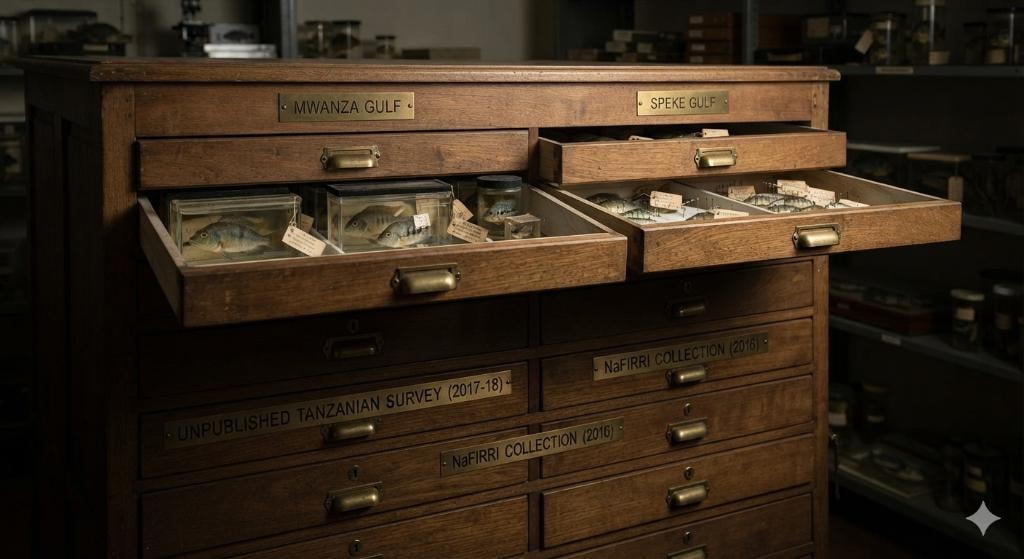
The most recent survey, conducted in 2017–18, quietly rediscovered dozens of species previously declared extinct — not because they had returned, but because someone finally looked somewhere else. The results were never published, never shared, never analyzed. The survey vanished, because its findings were too inconvenient to the narrative that had hardened into institutional fact.
Selected taxa
Representative Species
The Victorian radiation comprises an estimated 500–700 haplochromine species, the majority undescribed. The following taxa illustrate the trophic and morphological breadth of the extant flock — species that, according to the prevailing narrative, should not still be here.
Harpagochromis guiarti
(Pellegrin, 1904)
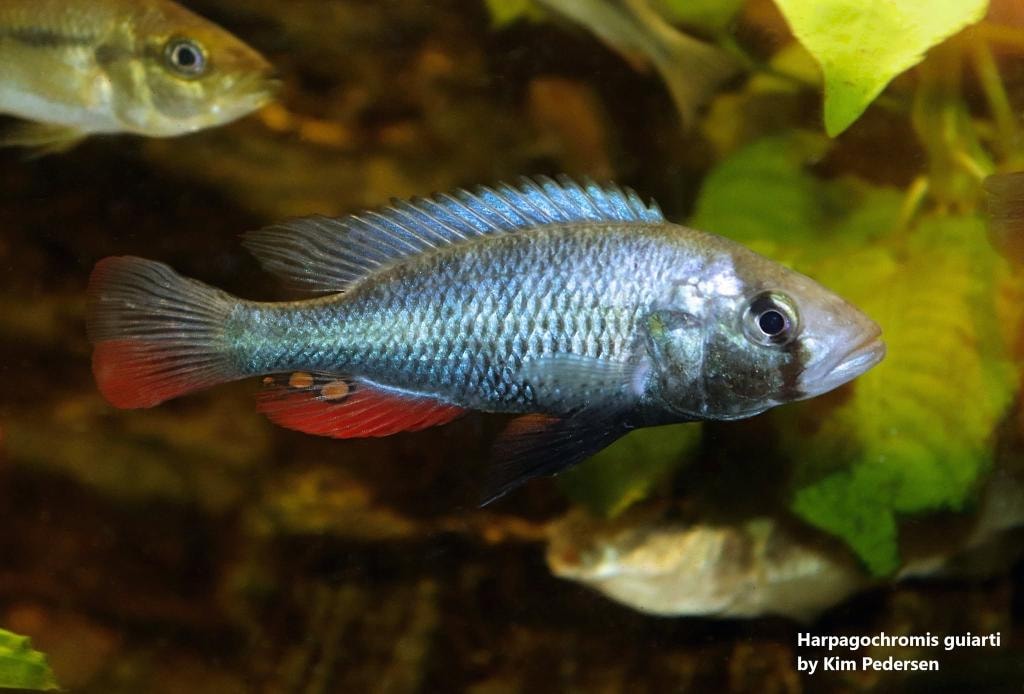
Piscivore; one of the larger predatory haplochromines of the open lake. Collected by Kim Pedersen and recorded in the 2017–18 lakewide survey — the same survey whose findings were never published. Its continued presence is not anomalous; it is what adequate sampling produces.
Pundamilia nyererei "Makobe"
Witte-Maas & Witte, 1985
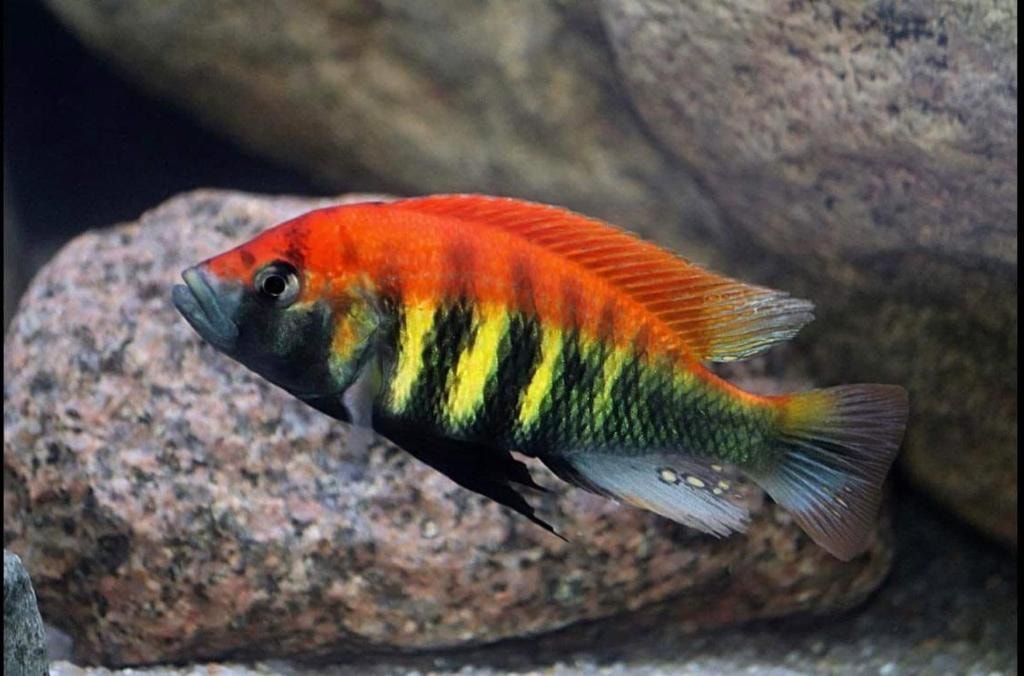
A species complex of morphologically similar insectivores endemic to a discrete island group in the Mwanza Gulf. The Mwanza Gulf is the most consistently studied region of Lake Victoria; population data here are more reliable than anywhere else in the lake. Each island population is effectively its own unit; the Makobe Island population is the best-studied reference point for most published work. Sexually dichromatic; extensively used as a model system for sympatric speciation via sensory drive.
Astatotilapia latifasciata
Regan, 1929
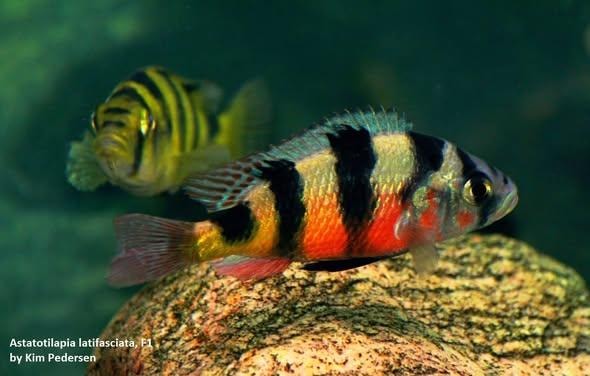
Kyoga satellite lake species; broad vertical bars, red male ventrum, blue dorsal. Lepidophage — a scale eater, not a molluscivore as frequently misreported. Broadly distributed across the Kyoga system but strictly solitary; low encounter rates in collecting reflect behaviour, not population collapse. Widely misidentified as H. obliquidens in the aquarium trade since the late 1970s — an error that persists despite taxonomic correction.
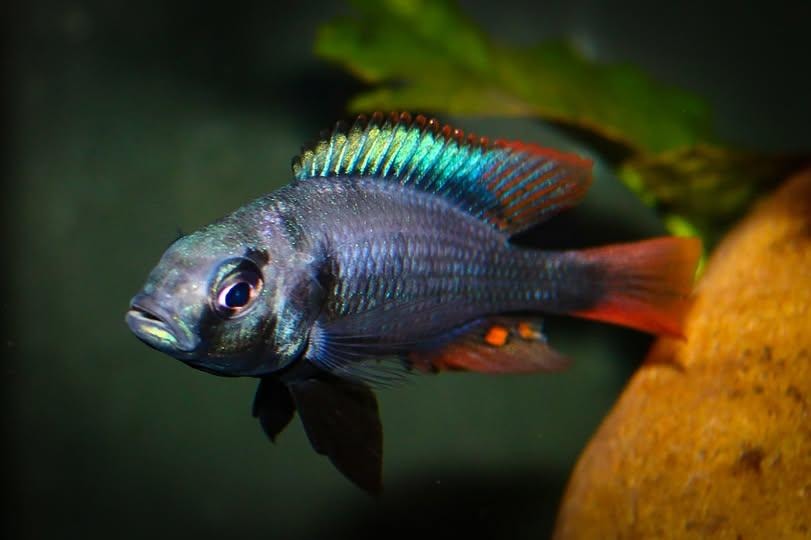
Lithochromis rubripinnis
van Oijen, 1991
A shallow-water mbipi of the rocky littoral, immediately recognizable by its red-tinted dorsal and caudal fins, metallic green-bronze body sheen, and clean vertical barring. A generalized scraper feeding on filamentous algae and diatoms. Morphologically stable across the lake's fragmented rocky habitats — one of the least ambiguous taxa in the Lithochromis assemblage.
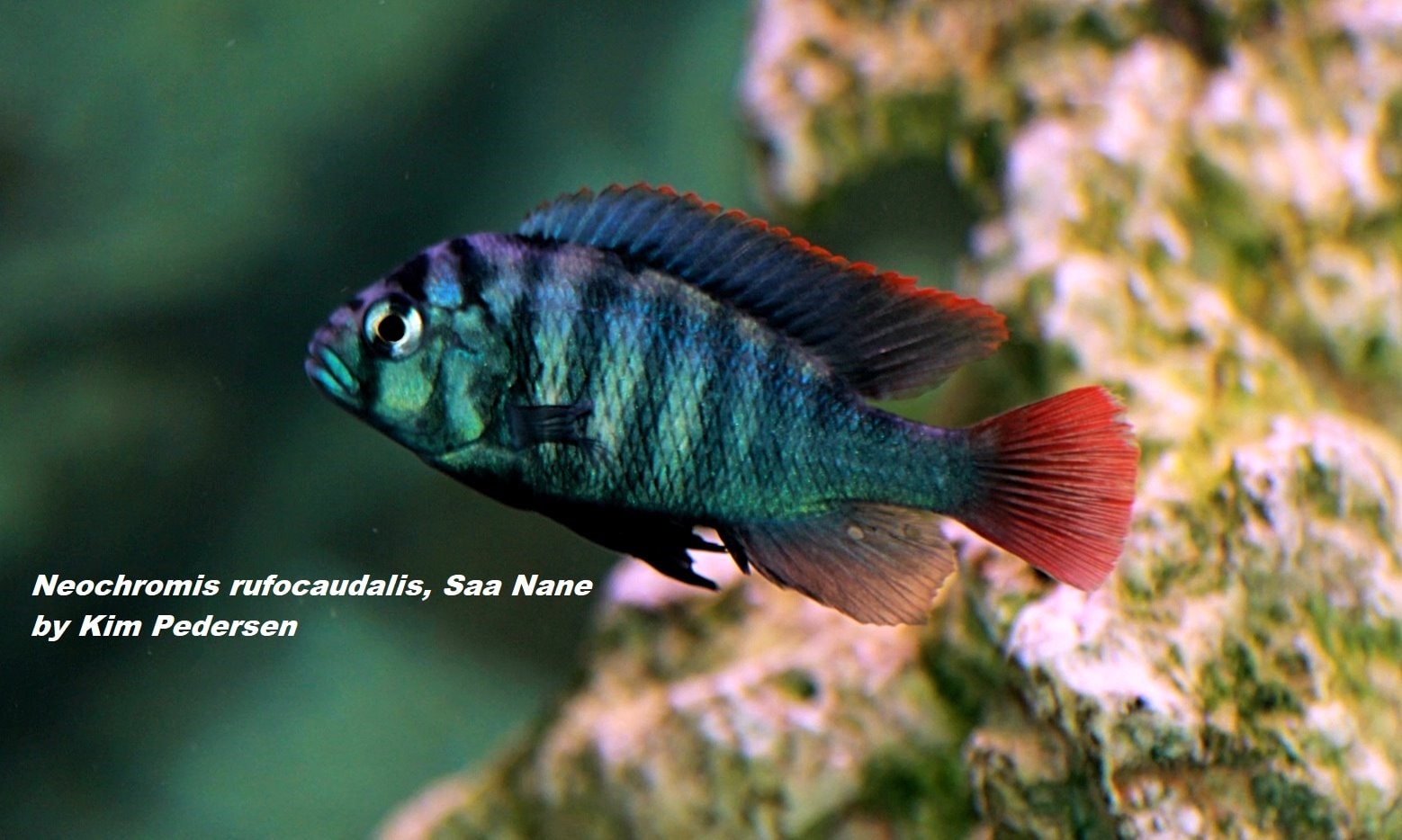
Neochromis rufocaudalis
Seehausen & Bouton, 1998
One of the most morphologically stable mbipi in Lake Victoria — a lakewide scraper whose apparent restriction to the southern basin was an artifact of uneven sampling. Collected in Jinja by Les Kaufman in 1992, photographed there again by Kim Pedersen in 2019, and depicted in the 2001 Upper Nile survey panels. Its red caudal fin, metallic green-bronze body, and clean vertical barring form a phenotype so distinctive that misidentification is virtually impossible.