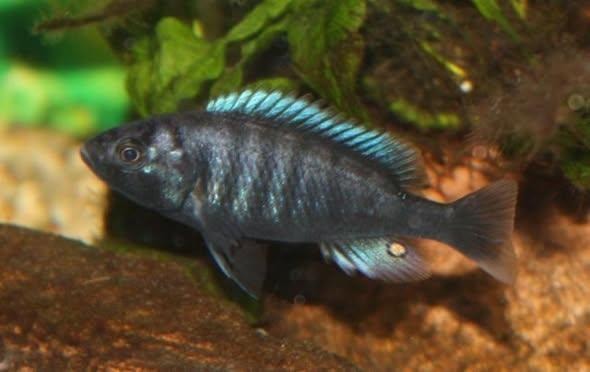
Mbipia: A Narrative Portrait of a Picker Guild Lineage
Mbipia is not a single species but a small lineage within the Lake Victoria radiation, shaped by the picker guild and expressed in four distinct forms that together tell a story of ecological pressure, habitat structure, and evolutionary persistence.
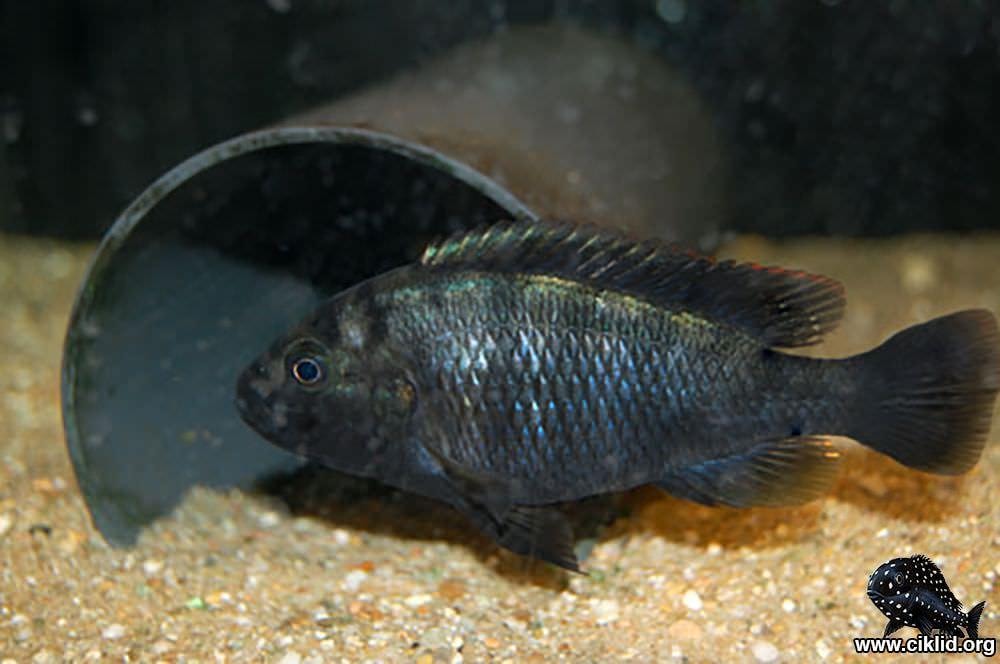
There are moments in the aquarium hobby when a fish does more than catch the eye. It opens a door. It invites you into a world that is larger than the tank, larger than the hobby, and rooted in the living architecture of a lake. Mbipia is one of those fishes. It is not a single species but a small lineage within the Lake Victoria radiation, shaped by the picker guild and expressed in four distinct forms that together tell a story of ecological pressure, habitat structure, and evolutionary persistence.
To understand Mbipia, you must begin with the picker guild itself. These are fishes that live close to the rock, not in the dramatic sense of the large predators or the bold scrapers, but in a quiet, deliberate way. They hover just above the surface, moving with a steady rhythm, and take small attached invertebrates one at a time. Their jaws are narrow and their movements precise. They defend small territories that contain the surfaces they feed on. They are not flashy in their behavior, but they are deeply specialized, and that specialization gives them a clarity that is rare in the Victorian radiation.
Mbipia is the clearest expression of this guild. It is a lineage that has persisted across regions and years, holding its shape even as the lake changed around it. It contains four forms, each shaped by the habitat it occupies and the pressures it faces. Together they form a continuum that shows how the picker guild behaves in rocky littoral systems, in benthic influenced zones, and in swamp margins where rock gives way to papyrus and submerged vegetation.
Mbipia mbipi
The first of these forms is Mbipia mbipi, the anchor species. It carries the ancestral picker guild morphology with a straight cranial profile, a narrow mouth, and a moderately deep body. Its flanks shimmer with a metallic green to blue sheen, and faint vertical bars appear when the fish is alert or territorial. The dorsal and caudal fins often carry reddish margins, and the anal fin bears distinct orange ocelli. It is a calm, steady fish that works the rock surface with quiet precision. In the aquarium it is one of the most rewarding Victorian cichlids to keep, because it shows the picker guild at its most stable and most expressive.
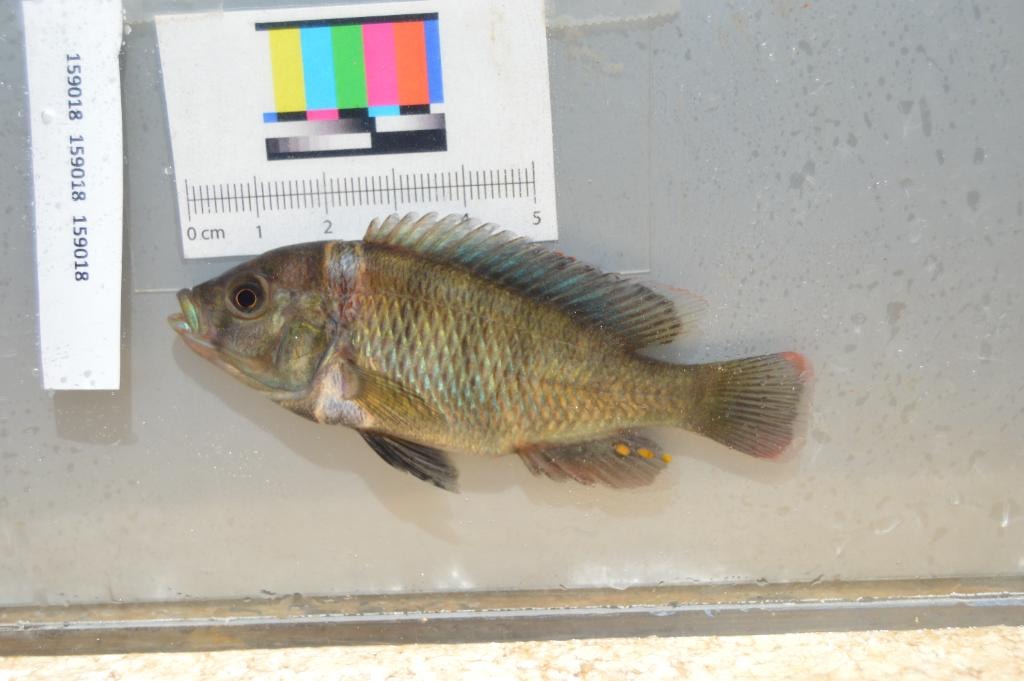
Mbipia mbipi — the anchor species of the picker guild lineage, showing the characteristic metallic green to blue flank sheen, faint vertical barring, and reddish fin margins. See the full species account: Mbipia mbipi.
Mbipia lutea
The second form is Mbipia lutea, the banded specialist. Lutea is unmistakable. Its vertical bars are strong and clear, its body slightly deeper, and its dorsal fin carries a blue-green base with a reddish margin. The caudal fin is reddish with orange ocelli. Lutea is tied to rocky littoral systems where picker guild structure is strong and benthic pressure is low. It has been documented in Mwanza in 2016 and at the Ssese Islands in 2017 and again in 2022. Across these years and regions the phenotype has remained unchanged. This stability is remarkable. It shows that picker guild architecture persisted through the Nile perch era and that lutea is one of the most coherent and resilient forms in the entire radiation.
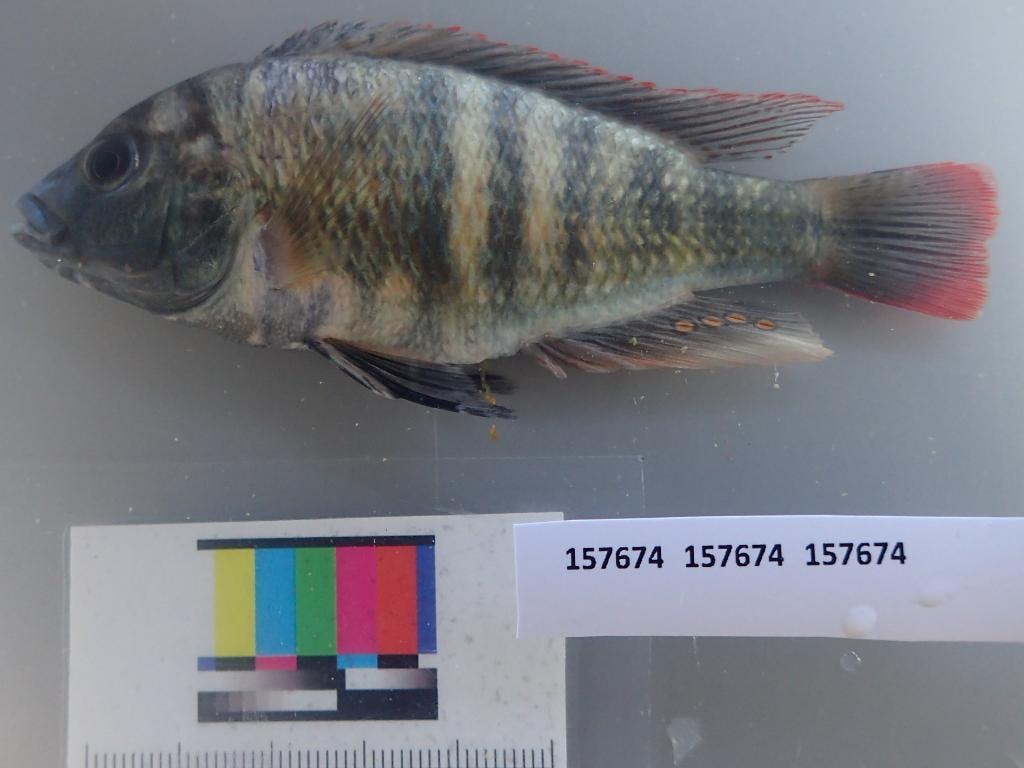
Mbipia lutea, 2017 Survey, Ssese Islands — strong vertical barring, blue-green dorsal base, reddish caudal fin with orange ocelli.
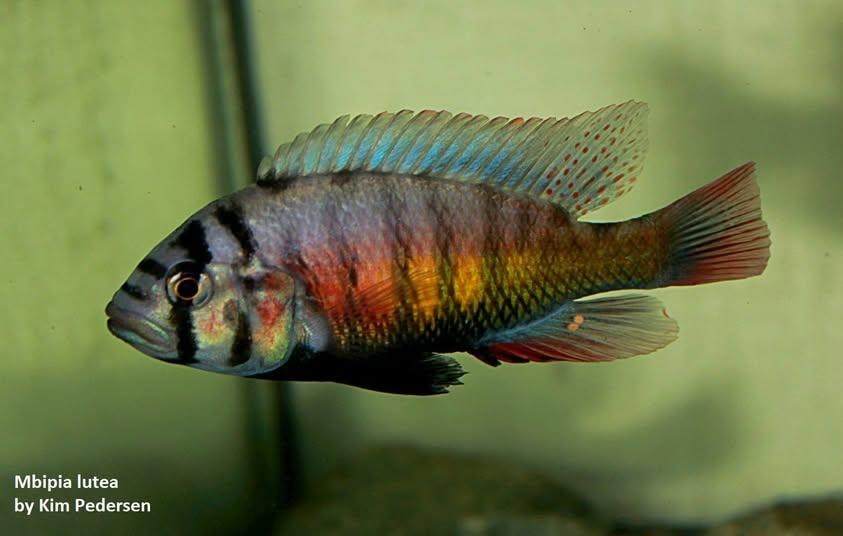
Mbipia lutea, aquarium specimen, Mwanza strain. Photo: Michel Hayoz. The phenotype is identical across the Ssese and Mwanza populations, separated by years and hundreds of kilometers. See the full species account: Mbipia lutea.
Mbipia sp. "red carp"
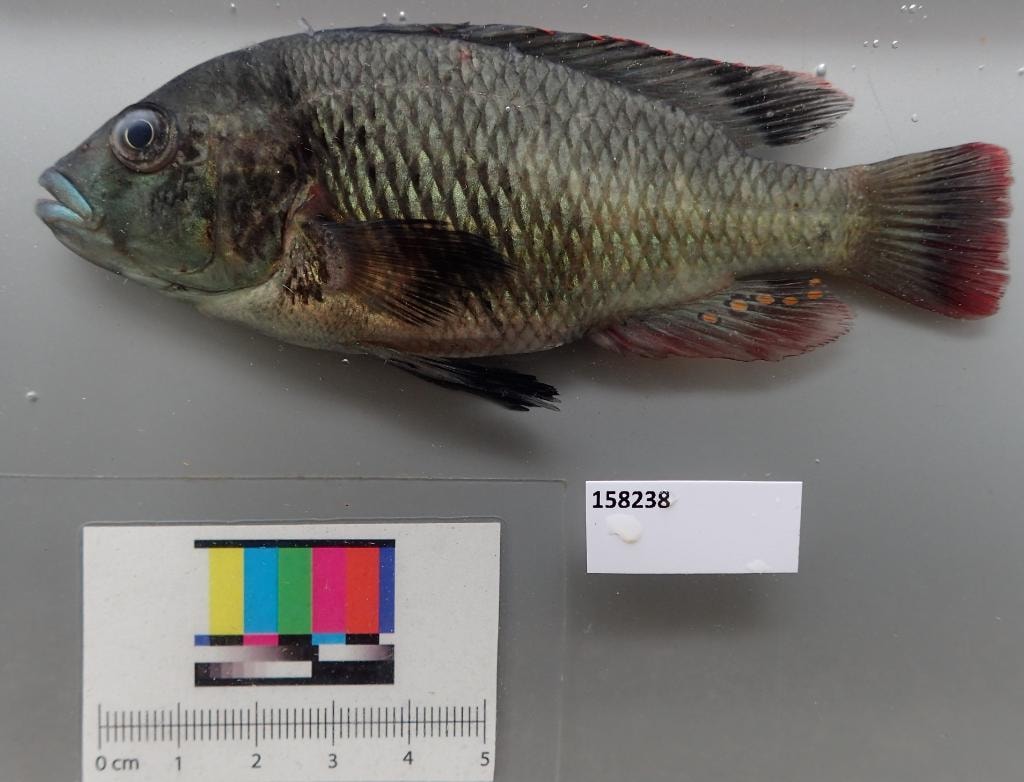
The third form is Mbipia sp. "red carp," a benthic-leaning hybrid echo that appears wherever benthic pressure increases but picker guild structure remains intact. It has a deeper body, enlarged scales, and reddish fins, but it retains the Mbipia cranial profile. Vertical bars are faint or absent. This morph has been documented in the northwest in 2017 and in Mwanza in 2022, and the phenotype is identical across these regions and years. It is not collapse debris. It is a predictable outcome of picker guild fishes living in benthic-influenced zones. It shows how the lineage responds to pressure without losing its identity.
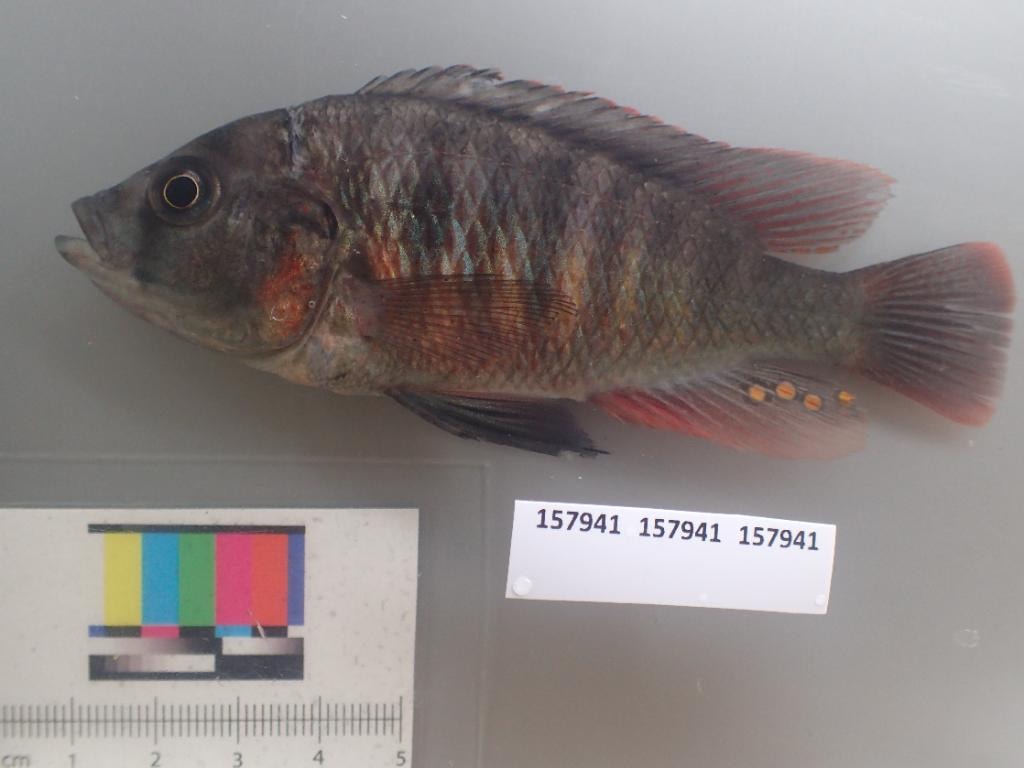
Mbipia sp. "red carp," catalog no. 157941 — deeper body, enlarged scales, reddish fins, Mbipia cranial profile intact. See the full species account: Mbipia sp. "red carp".
Mbipia sp. "Yala Swamp"
The fourth form is Mbipia sp. "Yala Swamp," a swamp-edge picker guild morph that appears in the papyrus corridors and vegetated pools of the Yala system. Here the picker guild must adapt to soft substrate, submerged vegetation, and high browser pressure. The fish carries horizontal striping instead of vertical bars, a yellow-green vegetative sheen, and a large tail ocellus that serves as a distraction mark in turbid water. The cranial profile remains Mbipia-typical, but the coloration and patterning reflect the swamp environment rather than the rocky littoral. This morph is not lutea and not a species. It is a local ecological expression of Mbipia in a browser-dominated swamp margin.
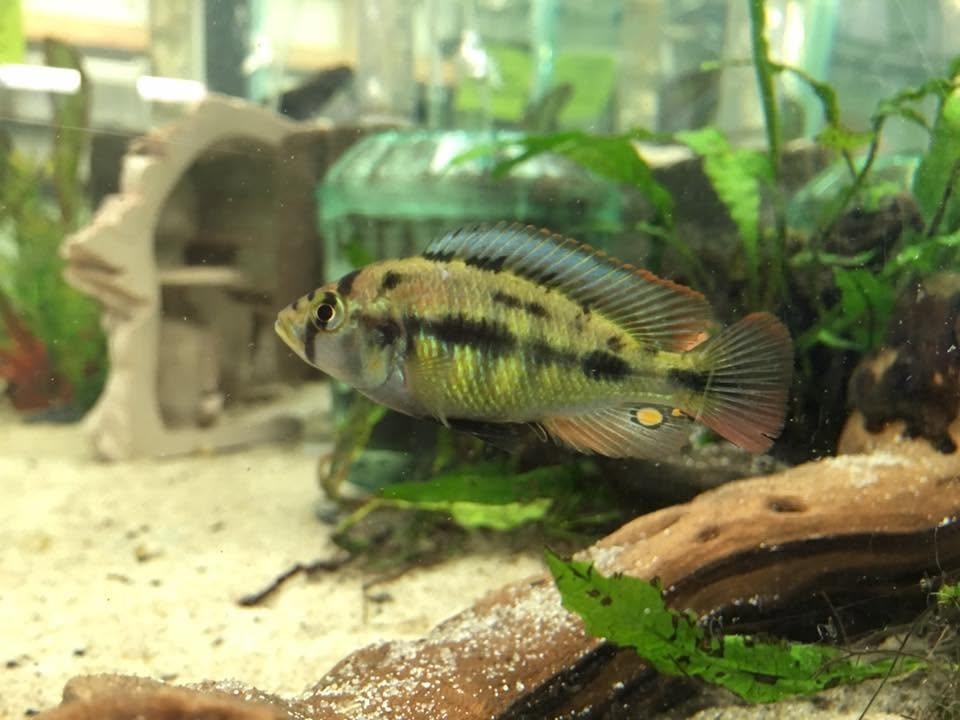
Mbipia sp. "Yala Swamp" — horizontal striping, yellow-green vegetative sheen, large tail ocellus. Photo: Lisa Hoeber. See the full species account: Mbipia sp. "Yala Swamp".
The Lineage as a Whole
For the hobbyist, these four forms offer a remarkable range of experiences. Mbipi is calm and steady. Lutea is striking and territorial. The red carp morph is bold and unusual. The Yala Swamp form is subtle and adaptive. Yet all four share the same underlying logic. They are picker guild fishes. They thrive when given structure, when the tank offers surfaces to work, and when their feeding strategy is respected.
In the aquarium, Mbipia species and morphs are straightforward to keep. They require rockwork or structured hardscape that provides vertical faces and narrow passages. They do not need caves. They need surfaces. Water conditions should be clean and stable, with moderate hardness and gentle flow. They feed best on small invertebrate-based foods such as cyclops, daphnia, and finely chopped mysis. Prepared foods with a strong invertebrate component work well. They do not require algae and do not thrive on heavy protein pellets.
Behaviorally they are territorial but not aggressive. Males defend small patches of rock, but they do not chase relentlessly. Females are calm and steady. They do well in groups and with other picker guild species. They should not be kept with large predators or highly aggressive benthic fishes. Breeding is straightforward. Males intensify their coloration and display over a small territory. Females mouthbrood for several weeks and release hardy fry that grow quickly.
Mbipia is a lineage that rewards attention. It is accessible to the casual hobbyist and endlessly interesting to the serious keeper. It shows how habitat shapes morphology, how guild structure persists across time, and how a small group of fishes can carry the ecological logic of an entire lake. To keep Mbipia is to keep a piece of Lake Victoria's living architecture, expressed in four forms that together tell a story of stability, adaptation, and quiet precision.