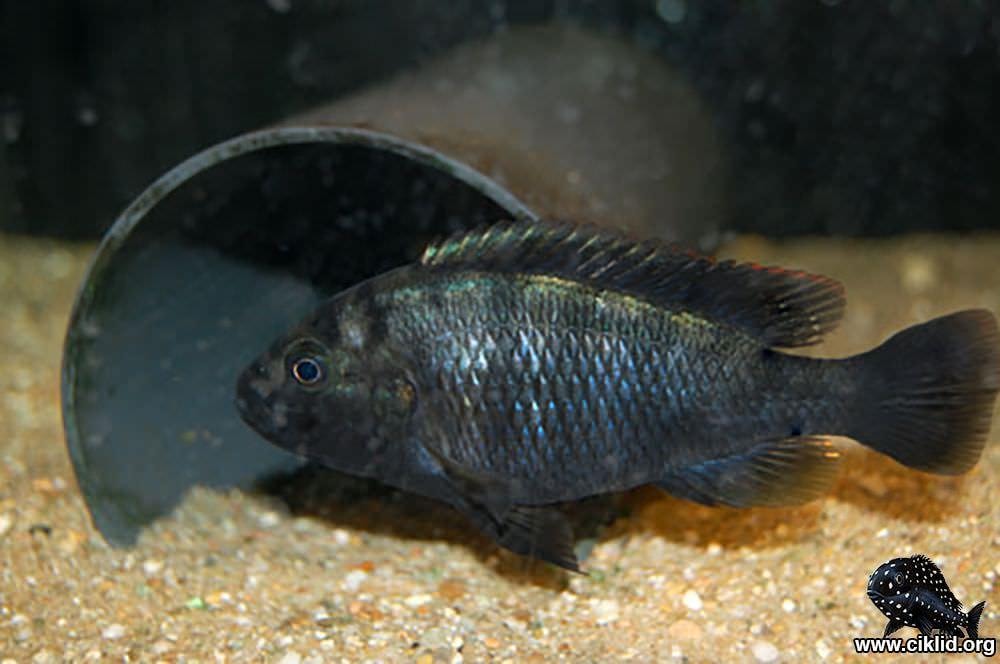
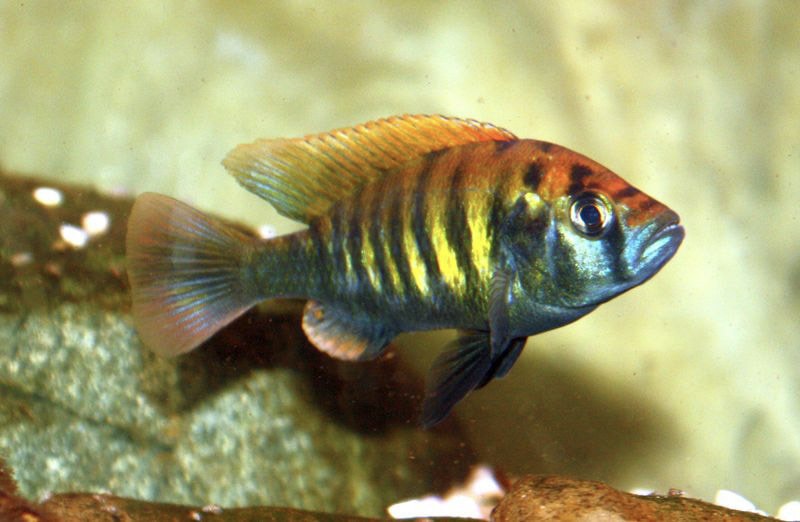
Pundamilia azurea — The Blue Mbipi of the Rock Faces
Among the rock-dwelling cichlids of Lake Victoria, Pundamilia azurea has always occupied a quiet but unmistakable place. Once you learn its look — the cool blue dorsal sheen, the steady vertical barring, the yellow ocelli glowing like lanterns on the anal fin — you begin to see azurea everywhere the lake offers rock and open water.
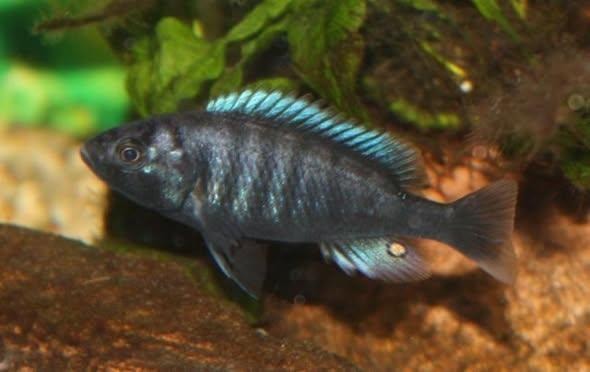
Among the rock-dwelling cichlids of Lake Victoria, Pundamilia azurea has always occupied a quiet but unmistakable place. It is not the most flamboyant of the mbipi, nor the most widely kept, nor the one that hobbyists immediately recognize from a distance. Yet once you learn its look — the cool blue dorsal sheen, the steady vertical barring, the yellow ocelli glowing like lanterns on the anal fin — you begin to see azurea everywhere the lake offers rock and open water. It is a fish that reveals itself slowly, and once it does, it becomes impossible to mistake.
For years, azurea was treated as a narrow endemic of the Speke Gulf islands, a relic of a period when southern Tanzania was the only region being sampled with any consistency. But as more material surfaced — old Ugandan collections, forgotten survey specimens, photographs from Napoleon Gulf, and even the Upper Nile panels — it became clear that azurea had never been confined to the south. It was a lakewide species, present wherever rock met plankton, and its quiet persistence across geography is one of the most compelling stories in the Victorian radiation.
Appearance and Character
Azurea males carry themselves with a kind of understated confidence. They do not blaze with the reds and yellows of Pundamilia nyererei, nor do they flare the fiery fins of P. igneopinnis. Instead, their beauty lies in a cooler palette: a metallic blue that gathers along the dorsal line and spills gently down the flanks, never garish, never overwhelming. The vertical bars are steady and evenly spaced, giving the fish a clean, ordered look. When a male is off display, he can darken to near black, the blue retreating until only the faintest shimmer remains. But when he rises into partial display, the dorsal edging lights up again, and the bars sharpen just enough to remind you that this is a true mbipi.
The anal fin ocelli are a signature trait. Azurea's ocelli are round, bright yellow to orange, and sharply defined even in preserved specimens. They stand out like punctuation marks on the fin, and they are one of the easiest ways to distinguish azurea from its congeners.
Females are quieter in appearance — brown to gray, faintly barred, and shaped with the same clean mbipi profile. They shoal readily and often mingle with female nyererei, which makes field identification difficult unless locality is known.
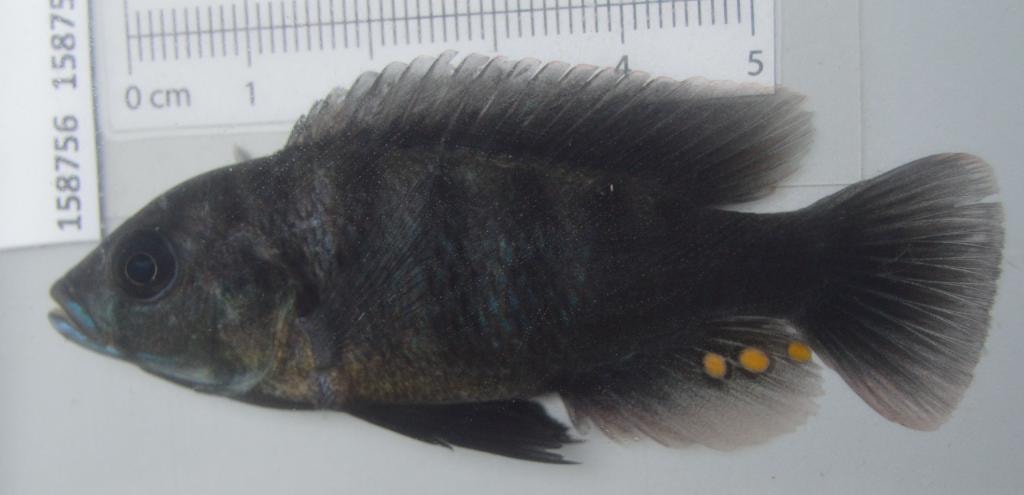
Pundamilia azurea, specimen 158756, 2017 Survey near Ssese Islands — the cool blue dorsal sheen, steady vertical barring, and bright yellow anal fin ocelli are all visible even in this field photograph.
Where Azurea Lives
Azurea is a fish of rock and open water. It favors steep boulder slopes, rocky promontories, and island margins where the substrate drops away into deeper water. But unlike many mbipi, azurea is not tied exclusively to the rock face. It feeds heavily on zooplankton, rising into the water column above the rocks and often joining mixed shoals of mbipi and juveniles of other species. This feeding strategy gives azurea a flexibility that many rock specialists lack, and it explains its broad historical distribution.
Confirmed records place azurea at:
- Ruti Island, the type locality
- Mwanza Gulf, where it was long known to hobbyists
- Napoleon Gulf, in Ugandan rocky promontories
- The Buvuma Islands, a complex archipelago of rock and mixed substrate
- The Entebbe–Kampala littoral, historically rich in mbipi habitat
- The Upper Nile corridor, documented in the 2001 panels
- The western Survey, including preserved specimens 158756–158757
This is not the range of a narrow endemic. It is the footprint of a lakewide mbipi that followed rock and plankton wherever they occurred.
Behavior and Ecology
Azurea males defend small territories on rock surfaces, displaying to passing females with a combination of body posture, fin flaring, and color shifts. They are assertive but not reckless, and they coexist well with other mbipi of similar size. Females mouthbrood for several weeks, releasing robust fry that grow quickly on plankton and small invertebrates.
Because azurea feeds in the water column, it often forms loose shoals with nyererei females and juveniles. This mixed-species association is common in the mbipi guild and reflects shared feeding opportunities rather than hybridization or territorial overlap.
How Azurea Differs from Its Relatives
Compared to P. nyererei — Azurea is cooler-toned, less saturated, and more evenly barred. Nyererei males show intense red and yellow, heavier barring, and more aggressive territorial behavior.
Compared to P. igneopinnis — Azurea lacks the fiery fin coloration and deeper body of igneopinnis. Its bars are more regular, and its blue is cooler and more metallic.
Compared to P. pundamilia — Azurea is deeper-bodied and more strongly barred. Pundamilia males are typically gray-blue with reduced barring and a more subdued appearance.
Azurea is not intermediate between these species. It is its own stable phenotype, recognizable across the lake.
In the Aquarium
Azurea is a rewarding fish for the serious hobbyist. It is hardy, active, and visually striking without being gaudy. It thrives in rocky hardscapes with vertical faces, moderate flow, and clean water. A diet rich in small invertebrates and planktonic foods brings out its best coloration.
Breeding is straightforward: one male with multiple females, plenty of rock cover, and stable water conditions. Females are reliable mouthbrooders, and fry grow quickly.
Pundamilia azurea male, Ruti Island strain, aquarium specimen. Photo: Michael Liu. The metallic blue dorsal edging and single anal fin ocellus are characteristic of the species in display condition.
Azurea is a fish that rewards attention. It is subtle, but not plain; calm, but not dull; and once you learn its rhythms, it becomes one of the most satisfying mbipi to keep. See the full species account: Pundamilia azurea.
A Species Worth Knowing
Pundamilia azurea is a reminder that Lake Victoria's story is broader, more dynamic, and far more continuous than the old narratives ever suggested. It is a fish that persisted quietly across the lake, moving through rocky promontories and island margins from Tanzania to Uganda, feeding in the open water above boulder fields, and shoaling with its mbipi kin in the same mixed guilds that have existed for thousands of years. Its presence in collections from Ruti Island, Napoleon Gulf, the Buvuma archipelago, the Entebbe–Kampala littoral, and even the western Survey shows that azurea was never confined to a single region or era. It is part of the living, shifting mosaic of the Victorian rock fauna — one of many species that endured, adapted, and remained recognizable across geography and time.