Pundamilia nyererei: The Southern Forms and Why Locality Integrity Matters
The southern populations of Pundamilia nyererei are the best documented members of the entire genus. They are the only nyererei forms that have ever entered the aquarium hobby — and the only ones that can still be preserved through careful, locality-specific breeding.
The southern populations of Pundamilia nyererei are the best documented members of the entire genus. They have been photographed, collected, and studied for decades, and they form the foundation of everything we know about nyererei biology, ecology, and mate choice. These are the only nyererei forms that have any presence in the aquarium hobby. No northern or corridor populations have ever entered captive circulation, and no other nyererei variants have been maintained or bred outside the lake. Because of this, the southern arc provides the clearest and most complete picture of the species, and it serves as the reference point for all work on Pundamilia.
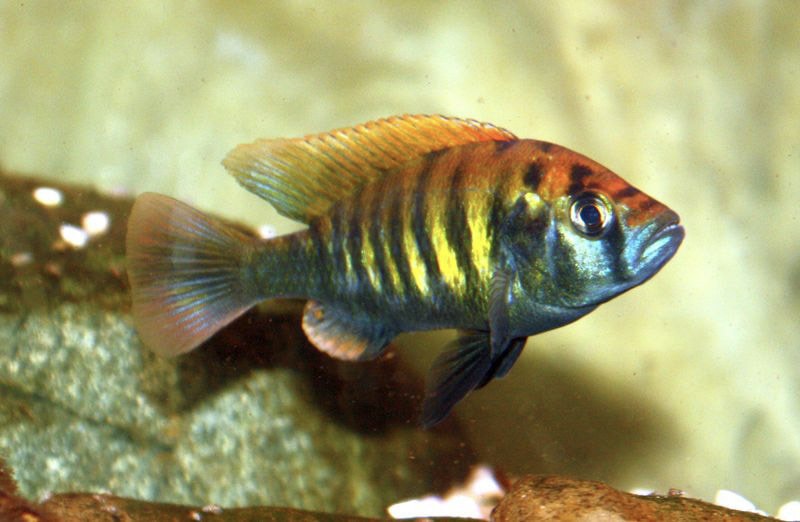
Pundamilia nyererei is a rock-dwelling cichlid that lives on shallow rocky islands and shorelines where light penetrates clearly and where algae, biofilm, and small invertebrates cover the stone. The southern arc of Lake Victoria — stretching across the Mwanza Gulf, the Speke Gulf, and the surrounding islands — is the heartland of the species. The males carry red backs and red dorsals, strong vertical bars, and flanks that shift from yellow to green depending on depth and light. The females are brown or gray and remain close to rock crevices. Although the pattern is recognizable across the region, each locality produces its own stable version, its own ecological fit, and its own evolutionary trajectory.
Makobe Island
Makobe Island is the best known of all. The males here carry a deep red dorsal, bright yellow flanks, and sharply defined bars. The color pattern is intense and unmistakable, and Makobe has become the reference form for the species. It is the population most often used in studies of sexual selection and mate choice, and it anchors the southern arc. The females show the classic brown-gray cryptic pattern and remain close to the rock faces.
Python Island
Python Island lies nearby but produces a very different fish. Python males are darker than Makobe males, with a deeper lower body and a red dorsal that shades toward orange. The flanks carry a more orange-yellow tone, and the bars are heavy and sharply defined. The pattern is stable and distinct, and Python stands as one of the clearest examples of locality-specific divergence. The females remain cryptic and stay close to crevices.
Ruti Island
Ruti Island produces a lighter, more yellow-green form. The males carry a red dorsal and softer bars, and the flank color shifts toward green in the shallower parts of the island. The head profile is slightly different from Makobe and Python, reflecting local feeding conditions. Ruti represents a shift toward greener light environments and shows how even small changes in water color can reshape male pattern.
Igombe Island
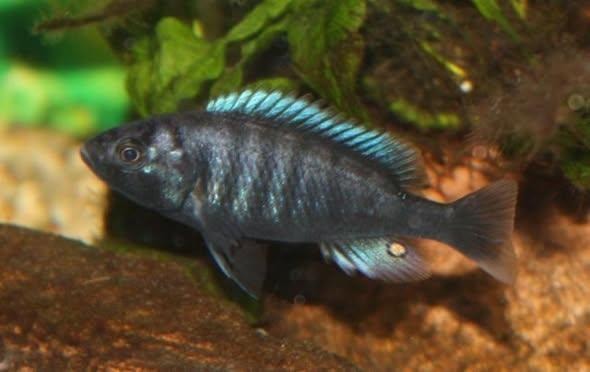
Igombe Island produces males with strong bars, darker lower bodies, and red dorsals that often shade toward orange. The upper flank frequently shows a metallic blue sheen. This population sits between the bright southern islands and the darker corridor populations, and it reflects the transitional nature of the habitat. The females remain cryptic and stay in the shallow crevice zones.
Anchor Island
Anchor Island produces one of the most visually striking southern forms. The males carry a deep red dorsal, a darker lower body, and a metallic upper flank. The bars are sharp and the body profile is slightly narrower. Anchor fish are adapted to steep rock faces and strong light gradients, and their pattern reflects that environment.
The Mwanza Gulf Islands
The Mwanza Gulf contains several small rocky islands, each with its own nyererei population. These forms share the classic red dorsal and barred pattern, but flank color varies from yellow to green depending on depth, substrate, and local light conditions. Each island produces its own stable version, and each should be treated as its own locality. The females across these islands remain cryptic and occupy the shallow crevice zones.
The Speke Gulf Islands
The Speke Gulf islands resemble the Mwanza forms but often show slightly darker lower bodies and more orange-red dorsals. These islands sit in a different light corridor and produce their own stable patterns. The Speke populations are distinct and must be kept separate from the Mwanza forms.
Ukerewe Island — Nansio Region
The southern shoreline of Ukerewe Island, often referred to as the Nansio region, carries a nyererei population that fits the southern pattern cluster. The males show red dorsals, strong bars, and subdued yellow flanks. This population marks the northernmost extension of the southern arc and forms the boundary between the well-studied southern forms and the largely undocumented northern tier.
Why Locality Integrity Is Not Optional
The southern arc is the most intensively studied part of the nyererei complex, but its importance goes beyond documentation. Each locality has its own stable male color pattern, its own female mate choice preferences, its own ecological adaptations, and its own evolutionary history. These differences are not cosmetic. They are the reproductive barriers that maintain population integrity. A Makobe female does not choose a Python male. A Python female does not choose a Ruti male. The color pattern is the mate recognition system, and it is the mechanism that keeps these populations separate in the lake.
For CARES participants, this is the central point. When a locality is mixed in captivity, the mate recognition system collapses. The distinct color patterns blend, the female preferences blur, and the resulting fish no longer correspond to any natural population. A mixed line cannot be restored to purity. Once the locality signal is lost, it is lost permanently.
The southern arc is the only part of the nyererei complex that exists in the hobby, and it is therefore the only part that can be preserved through careful, locality-specific breeding. Listing each locality separately is not a matter of record keeping. It is the only way to preserve the evolutionary structure of the species.
The southern forms of Pundamilia nyererei are the best documented, the most stable, and the only ones available to aquarists. They must be kept separate because each locality represents a distinct evolutionary path shaped by light, depth, substrate, and mate choice. When these populations are maintained as they exist in the lake, they preserve the natural diversity of the species. When they are mixed, that diversity disappears.