Field Survey
The Upper Nile Corridor: A Hidden Radiation
The Uganda Freshwater Portal contains species lists that should not exist — Neochromis simotes, Pundamilia pundamilia, Mbipia mbipi, and dozens of undescribed forms, all collected from the Upper Nile. This is not a depauperate remnant. It is a living, unstudied Victorian radiation.

The Uganda Freshwater Portal was never intended to be a biodiversity archive. It was built for fisheries management, hydropower compliance, and water quality monitoring. Somewhere along the way, a field technician or a data manager began uploading photographs, locality maps, species labels, specimen counts, habitat notes, GPS coordinates, and collection metadata. And then the material sat there, untouched, for almost twenty years.
Until now.
What the Portal contains is not a footnote. It is an entire radiation. The species lists from the Upper Nile and the Nile to Buvuma corridor are among the most important haplochromine records assembled since the 1920s, quietly preserved in a public database that no one in the scientific community ever thought to examine. The assumption was simple: Uganda had nothing to offer. The Portal proves otherwise.
This article is the first attempt to describe what is actually there.
The Upper Nile: A Living Radiation
The first revelation from the Portal is that the Upper Nile is not a spillway or a depauperate remnant. It is a living, diverse, unstudied Victorian radiation.
The species list alone makes this clear. The Upper Nile collections include Neochromis simotes, Neochromis nigrescens, Neochromis greenwoodi, Neochromis gigas, Mbipia mbipi, Pundamilia pundamilia, Pundamilia azurea, Pundamilia macrocephala, Pundamilia igneopinnis, Astatotilapia brownae, and Astatoreochromis alluaudi. These are not fringe taxa. They are core Victoria radiation species, including some of the most iconic and ecologically specialized lineages in the lake. Their presence in the Nile shows that the river is not a peripheral habitat. It is a parallel evolutionary theatre that has been running quietly for decades.
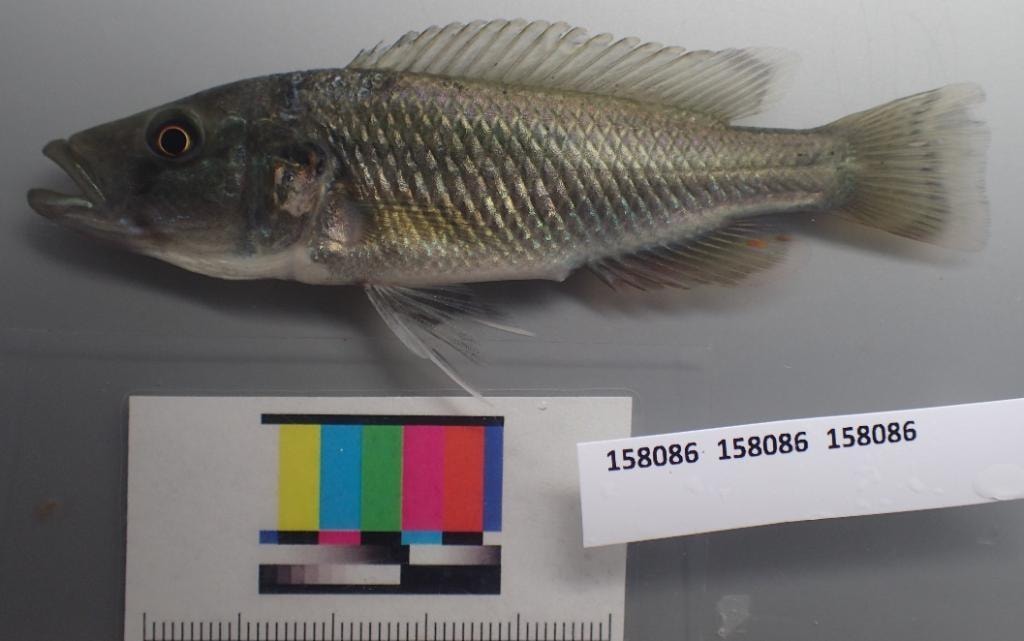
The undescribed forms are even more striking. The Portal records Mbipia sp. "all black," Psammochromis sp. "yellow," Haplochromis sp. "purple yellow," Xystichromis sp. "red dorsum," Pundamilia sp. "black," Paralabidichromis sp. "yellow anal fin," and Astatotilapia sp. "elongate," including twenty-three specimens of a clearly defined elongate lineage that is not a fluke. These are not oddballs. They are coherent, morphologically stable species that fit neatly into Victoria clades but are not known from Victoria itself.
The Pundamilia radiation alone is extraordinary. The Portal lists Pundamilia sp. "redtail," Pundamilia sp. "black," Pundamilia azurea, Pundamilia macrocephala, Pundamilia igneopinnis, and Pundamilia pundamilia. This is not a stray population. It is a full radiation. Victoria's Pundamilia complex is famous for its explosive color diversification. Seeing the same pattern in the Nile, including forms unknown from Victoria, suggests either parallel evolution, retained ancestral polymorphism, or a shared radiation far older and more widespread than anyone realized.
Any of these possibilities would be remarkable.
The Nile to Buvuma Corridor: The Spine of the Northern Radiation
Tracing the geography from the Upper Nile down through Jinja, Buvuma Island, the small islands south and west of Buvuma, and into the Victoria basin reveals a single ecological gradient that has been uninterrupted for thousands of years. The species list shows Neochromis, Mbipia, Pundamilia, Xystichromis, Psammochromis, Paralabidichromis, Astatotilapia, and Astatoreochromis distributed along this corridor. This is not a random assortment. It is the full Victorian guild structure, present outside the lake, flowing into the lake, and diversifying again on the islands.
The corridor is not merely a dispersal route. It is a refugium. Species that were heavily impacted by Nile perch in the main lake, including Neochromis nigrescens, Neochromis greenwoodi, Neochromis gigas, Mbipia mbipi, Pundamilia azurea, Pundamilia macrocephala, and Pundamilia igneopinnis, appear healthy in the Nile corridor. Some are diminished in the southern lake. Some are rare or restricted in habitat. Yet they persist here.
The islands south and west of Buvuma are the keystone of this system. They sit at the midpoint between the Nile fauna and the Victoria basin fauna, and they contain Nile species, Victoria species, unknown species, color morphs absent from the lake, elongate Astatotilapia in numbers, multiple Pundamilia forms, multiple Mbipia forms, and Psammochromis and Xystichromis analogues. This is exactly what one would expect in a contact zone where two radiations meet and interact, but it has never been documented.
The corridor also resolves several long-standing puzzles. Nile species appear sporadically in Victoria collections because they are not sporadic; they are part of a continuous gradient. Some Victoria species show Nile-like morphotypes because the corridor allows gene flow and parallel evolution. The northern lake has unexpected diversity because the corridor feeds it.
The Political Blind Spot
The reason this corridor remained invisible for thirty years is not biological. It is political.
For decades, Uganda and Tanzania were institutionally hostile and scientifically non-cooperative. Uganda did not permit Tanzanian scientists in its waters. Tanzania did not permit Ugandan scientists in its waters. NaFIRRI and TAFIRI were not just unaligned; they were actively opposed to cross-border work.
Ole Seehausen's research program was built around specific evolutionary questions, including hybridization, trophic guild collapse, adaptive radiation, and speciation under ecological stress. These questions required high-resolution sampling of rocky habitats, not broad coverage of the entire lake. His work was transformative, but it was not a lake-wide survey. And critically, he could not work in Uganda. The political boundary was absolute.
This is why his maps show half a lake. This is why his species lists look incomplete. This is why his evolutionary models rely on southern arc data. It was not a scientific oversight. It was a geopolitical constraint.
The IUCN extrapolated collapse-zone data across the entire lake. That was a mistake — not Ole's, since he never claimed to have assessed extinction lake-wide. The phrase "deeply threatened" became a narrative built on partial data.
NaFIRRI Collected the Evidence and Then Lost Sight of It
NaFIRRI's mission was fisheries management, hydropower compliance, commercial stock monitoring, Nile perch dynamics, and water quality. Haplochromines were not part of their mandate.
So when field teams collected Neochromis simotes, Neochromis nigrescens, Mbipia mbipi, Pundamilia azurea, dozens of undescribed species, color forms, and morphotypes, they photographed them, measured them, logged them, and filed them away. Not because they were careless. Because haplochromines were outside their scope.
The result is surreal. Uganda collected the most important modern haplochromine dataset in East Africa and then forgot it existed.
The Portal became an accidental archive. Someone uploaded the data, and then no one ever looked at it again. The global haplochromine community, perhaps twenty to thirty people worldwide, was fragmented, underfunded, focused on Tanzania, focused on Ole's work, focused on the collapse zone. They assumed Uganda had no data, NaFIRRI had no interest, the Nile had no surviving species, and the northern arc was depauperate. So they never checked the Portal.
The extinction narrative blinded them.
Kyoga: The Second Great Radiation
The Portal data does not end at the Upper Nile. The Kyoga lakes are filled with fish — diverse, abundant, and almost entirely undescribed in the haplochromine literature.
Kyoga is not a satellite lake. It is a basin — sprawling, shallow, ecologically complex, with papyrus margins, macrophyte beds, sand shelves, riverine inflows, swamp corridors, vegetated islands, deep pockets, and open water zones. It is an engine for haplochromine diversification. And unlike Victoria, Kyoga never experienced a full trophic collapse. Its structure protected it: shallow water, vegetation, swamp connections, nursery zones.
NaFIRRI collected Mbipia, Pundamilia, Paralabidichromis, Psammochromis, Xystichromis analogues, Astatotilapia complexes, paedophages, sand dwellers, swamp specialists, riverine predators, and transitional guild species, and then filed the data away.
The Portal map for "Lipochromis parvidens," showing thirty-nine occurrences around Kyoga and the Victoria Nile districts, illustrates the problem. That distribution is impossible for the true Lipochromis parvidens, the littoral predator Greenwood described and Kim Pedersen rediscovered in Napoleon Gulf. The Portal is mapping the Kyoga paedophage complex — a cluster of brood-raiders lumped under the wrong name. The confusion itself is diagnostic: NaFIRRI was collecting paedophages in Kyoga in numbers, logging them, and filing them under whatever name was available.
Kyoga is the next chapter. Thirty-nine occurrences for one misidentified paedophage implies dozens of species beneath it. Kyoga is not a lake. It is a radiation engine.
A Footnote That Became a Clue
One final detail ties this reconstruction together. In Ole Seehausen's book, a single photo caption notes that the red fin piebald was collected above Jinja.
He did not emphasize it or explore it. He simply recorded it and moved on. Because the scientific world was focused on the collapse zone, no one noticed.
But in the context of the Nile corridor, that caption becomes a clue. It means Ole had at least one specimen from the Upper Nile, likely mislabeled as barbarae, since both species are polymorphic, both produce blotched offspring, and both circulated under vague labels like "Jinja hap." Ole accepted the label and could not pursue it because Uganda was off limits.
He had one breadcrumb. The Portal contains the whole loaf.
What This Means
The extinction narrative was not wrong because Ole was wrong. It was wrong because half the lake was invisible. Tanzania studied the south. Uganda collected everything and studied nothing. And no one studied the corridor between them.
Half the lake's biodiversity was hidden in plain sight, in a fisheries database no one thought to open, in a country no one thought to ask, in a corridor no one thought to trace.
The Upper Nile is now the most important unexplored haplochromine region in East Africa. And the corridor that runs from it down through Jinja, Buvuma, and the Buvuma archipelago into the Victoria basin is the spine of the northern radiation — the mechanism that explains the persistence of pre-dam lineages, the survival of rare Neochromis, the richness of Pundamilia forms, and the presence of entire guilds declared extinct.
This is not a minor correction. It is a fundamental rewrite.