Science
What Is a Species? The Victorian Haplochromines and the Limits of Biological Categories
The word "species" feels solid. But the more closely one looks at the Victorian haplochromines, the more that solidity dissolves.
What Is a Species? The Victorian Haplochromines and the Limits of Biological Categories
The word "species" feels solid. It feels like a boundary, a definition, a box into which living things can be placed. It feels like the most basic unit of biology, the thing that naturalists name, that museums preserve, that conservationists protect, and that hobbyists trade. But the more closely one looks at the Victorian haplochromines, the more that solidity dissolves. The species concept, which seems so straightforward in textbooks, becomes fluid, porous, and unstable in the face of real evolutionary dynamism.
Taxonomists are trained to name things. Their work depends on drawing boundaries, assigning labels, and creating categories that allow communication. When Greenwood described Haplochromis crassilabris in 1957, he was working within a system that required him to assign a species name even when the fish in front of him showed signs of hybridization, transitional morphology, and ecological fluidity. He wrote species descriptions because that was the language of the discipline, not because the fish behaved like discrete, bounded entities. Many Victorian "species" were named under similar constraints: they were snapshots of a moving process, attempts to freeze a moment in an evolutionary film.
Evolutionary biologists see species differently. To them, a species is not a fixed unit but a phase — a temporary configuration of genes, behaviors, ecologies, and morphologies. In a radiation like Lake Victoria, species are not endpoints. They are experiments. A species is cohesive only for as long as its population behaves as a unit. Cohesion can dissolve. Gene flow can resume. Hybridization can occur. Ecological shifts can happen. A species can become two species, or two species can become one. In the Victorian system, this happens constantly. The boundaries are porous. Identity is fluid. The radiation is alive.
This difference in perspective creates a quiet tension between taxonomists and evolutionary biologists. Taxonomists freeze the film. Evolutionary biologists watch it move. Taxonomists describe what is in front of them. Evolutionary biologists describe what is happening behind it. Taxonomists need names. Evolutionary biologists need processes. Both are correct within their own frameworks, but the Victorian haplochromines expose the limits of both.
The Radiation Refuses to Sit Still
The Victorian radiation refuses to sit still long enough to be named. It hybridizes. It shifts trophic roles. It changes coloration. It moves between habitats. It recombines. It diverges. It converges. It behaves like a radiation, not like a set of discrete species. The crassilabris complex is the perfect example. Greenwood named it. Wikipedia declared it extinct. The surveys found it alive. The hobby kept it unknowingly. And the lineage expressed itself explosively in captivity. A taxonomist sees a species. An evolutionary biologist sees a lineage in motion.
This is why the species concept breaks down in the face of real evolutionary dynamism. It is not that species do not exist. It is that species are not what most people think they are. They are not fixed units. They are not immutable categories. They are not the fundamental building blocks of nature. They are evolving populations, shaped by ecology, behavior, geography, and chance. They are temporary arrangements of traits that may persist for centuries or dissolve in a decade.
The Victorian haplochromines make this visible. They show that species are gradients, not boxes. They show that identity is fluid. They show that evolution is ongoing. They show that the boundaries we draw are conveniences, not truths. They show that the lake is not a museum of species but a living engine of diversification.
Why the Hobby Struggles
This is why the hobby struggles. It tries to force fluid lineages into rigid categories. It tries to treat developmental plasticity as impurity. It tries to treat hybridization as contamination. It tries to treat riverine behavior as aberration. It tries to treat volatility as instability. It tries to treat variation as error. It tries to treat lineages as species.
But the fish do not cooperate.
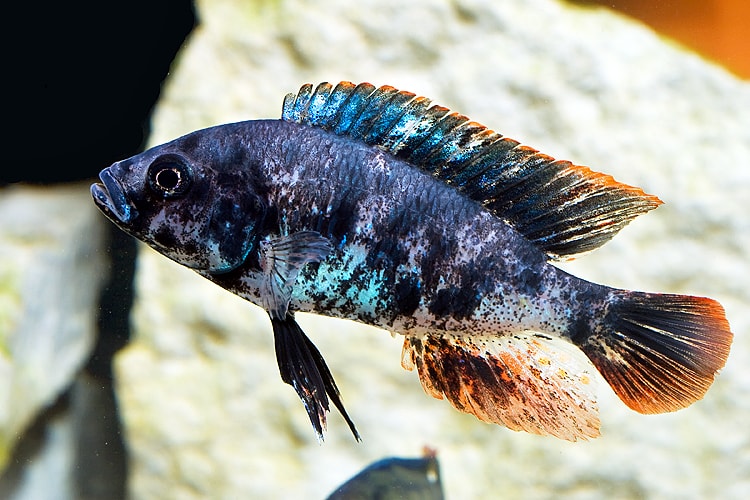
Red Fin Piebald is not a species. It is a riverine haplochromine lineage expressing the full developmental plasticity of the Victorian radiation. Crimson Tide is not a species. It is a coherent trophic lineage that stabilized under ecological pressure. The "extinct" species in the literature are not extinct. They are unrecognized. The "hybrids" in the hobby are not hybrids. They are lineages expressing latent pathways. The "species" in the lake are not fixed. They are evolving.
The Victorian radiation forces us to confront the limits of the species concept. It forces us to see evolution not as a historical event but as a present tense. It forces us to recognize that the categories we use are tools, not truths. And it forces us to understand that the fish in our tanks are not representatives of static species but participants in an ongoing evolutionary experiment.