Ecology
Habitat Zones of Lake Victoria: Where Cichlids Live and Why It Matters
Lake Victoria is not one habitat — it is four distinct ecological zones, each shaped by depth, substrate, light, and oxygen. Understanding them is essential to understanding the cichlid radiation.
Habitat Zones of Lake Victoria: Where Cichlids Live and Why It Matters
Lake Victoria is not a single, uniform body of water. It is a mosaic of four ecologically distinct zones — vegetated littoral, rocky, open water, and wetland — each with its own substrate, light regime, oxygen profile, and food base. The haplochromine cichlid radiation did not happen in spite of this complexity. It happened because of it.
Understanding these zones is not background knowledge. It is the foundation for understanding why so many species exist, why they look the way they do, and why the loss of any one zone carries consequences that extend far beyond the species that live there.
Vegetated Littoral
The vegetated littoral zone occupies the shallow margins where submerged and emergent macrophytes — primarily Ceratophyllum, Vallisneria, and papyrus at the edges — create a structurally complex environment. Light penetrates fully here, and the substrate is typically soft mud or fine sand accumulated beneath plant cover.
This zone supports a disproportionate share of the lake's invertebrate biomass. Chironomid larvae, gastropods, and small crustaceans colonize the sediment and plant surfaces in high densities. The haplochromines that evolved here are predominantly invertivores and detritivores — species with fine gill rakers, small mouths, and the behavioral flexibility to forage across multiple microhabitats within a single territory.
The vegetated littoral is also the primary nursery habitat for juveniles of many species that, as adults, occupy other zones. Its degradation through eutrophication and water hyacinth encroachment therefore affects recruitment across the entire lake, not just the species that reside there permanently.
Rocky Littoral
The rocky littoral is the most species rich zone per unit area in Lake Victoria. Boulders, cobble, and vertical rock faces create a three dimensional habitat with strong light, high oxygenation driven by wave action, and dense epilithic algal growth. This biofilm of diatoms, cyanobacteria, and green algae forms the base of a distinct food web.
The cichlids of the rocky littoral are among the most specialized in the lake. Algal scrapers and grazers have evolved robust dentition and flattened snouts for removing biofilm from exposed rock. Crevice feeders use forceps like jaws and thickened lips to extract insect larvae from fissures. Paedophages and scale eaters exploit the concentration of mouthbrooding females and territorial males. Piscivores patrol the rock sand interface where prey species are exposed.
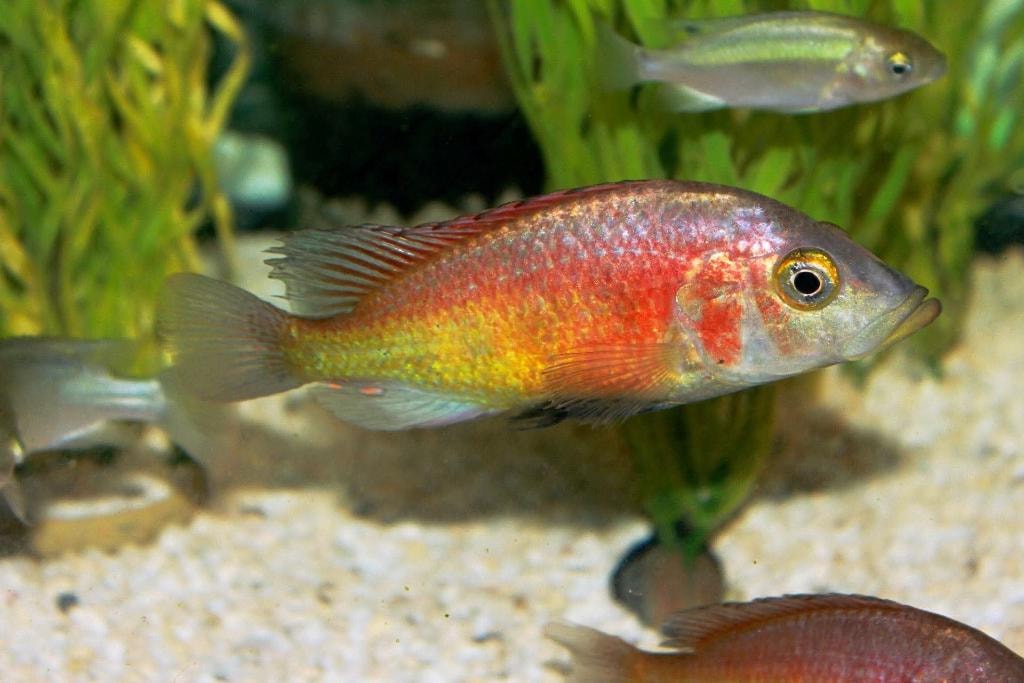
Pundamilia nyererei and Paralabidochromis chilotes are both characteristic rocky littoral mbipi, though they occupy different microhabitats within the zone. P. nyererei is strongly associated with the rock sand ecotone. P. chilotes is a crevice specialist that works the vertical rock faces and fissured boulder fields where insect larvae are abundant.
The rocky littoral is also where male coloration is under the most intense visual selection. Steep light gradients created by depth and turbidity mean that the spectral environment changes over only a few meters. These gradients have been implicated in the rapid divergence of male nuptial coloration among closely related mbipi species.
Open Water
The pelagic zone — open water beyond the littoral shelf — is the least structurally complex habitat in the lake, but it supports some of its most ecologically important species. Zooplanktivores, including the endemic Yssichromis species flock, exploit the dense concentrations of cyclopoid copepods and cladocerans that characterize the upper water column.
Open-water haplochromines are typically slender, fusiform, and silvery — body forms that reduce drag and minimize visual contrast in a featureless, well-lit environment. Their gill rakers are long and closely spaced, adapted for filtering small prey items from the water column at speed.
Yssichromis pyrrhocephalus is the best-documented member of this guild. Its distribution is lake-wide, and it was historically one of the most abundant haplochromines in commercial trawl catches. The collapse of zooplanktivore populations following Nile perch expansion had cascading effects on nutrient cycling and algal dynamics that are still not fully understood.
The open-water zone is also where oxygen depletion is most consequential. Seasonal stratification creates an anoxic hypolimnion that can extend into the lower water column, compressing the available habitat for pelagic species and concentrating them in a narrowing oxygenated layer near the surface.
Wetland and Satellite Lakes
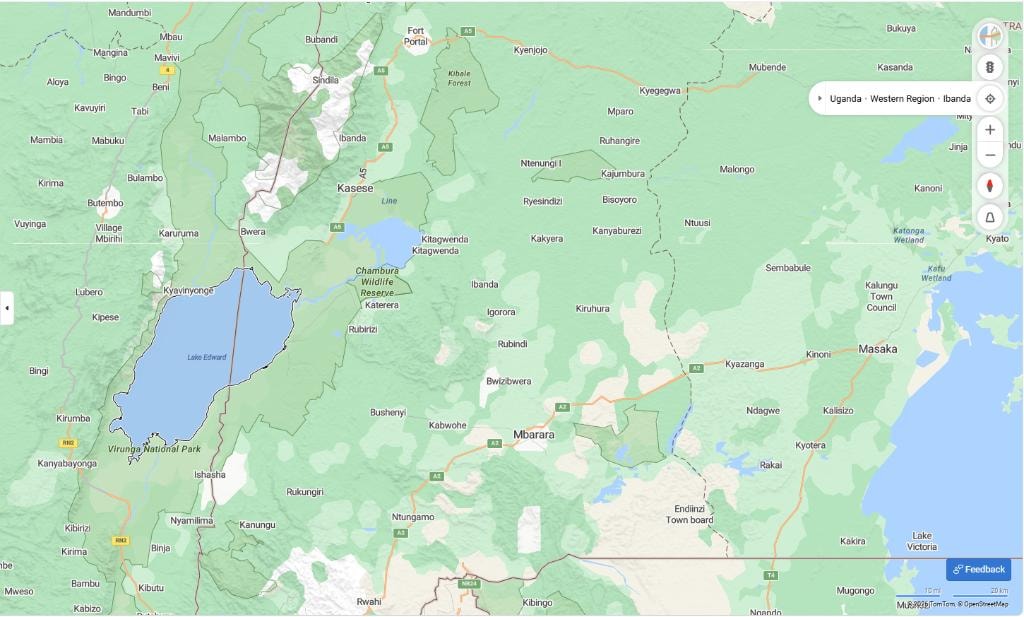
The wetland fringe — papyrus swamps, flooded grasslands, and the shallow bays of satellite lakes including Nawampasa, Kyoga, and Nabugabo — represents a fourth ecological context that is often overlooked in accounts focused on the main lake basin.
These habitats are characterized by low light, soft substrate, high organic content, and variable oxygen. They are not refugia in a passive sense — they are active evolutionary theaters. The Kyoga Basin in particular has produced a distinct cichlid fauna with affinities to both the Victoria and Albert radiations, and several undescribed species collected from Lake Nawampasa in 2017 and 2019 represent lineages with no confirmed presence in the main lake.
Wetland and satellite lake habitats are also the most likely refugia for species that have become rare or undetectable in the main lake. The sampling effort directed at these habitats has been minimal relative to their potential significance, and the species lists for most satellite lakes remain provisional.
Why Zone Matters for Conservation
The four-zone framework is not merely descriptive. It has direct implications for how we think about conservation priorities.
A species is not just a name on a list — it is a set of ecological relationships embedded in a specific habitat context. Losing the vegetated littoral does not just affect vegetated littoral species. It affects recruitment for rocky littoral species, nutrient dynamics for the open water, and the connectivity between the main lake and satellite habitats.
The cichlid radiation of Lake Victoria is a product of habitat heterogeneity. Protecting it requires protecting that heterogeneity — not just individual species, but the zones that made them possible.